
Industrial plants run in shifts because the work never stops. As customer deployments grew from single robots to fleets, the robots became a shift of their own, covering scheduled rounds around the clock and handing over what they find to the teams and systems that act on it. Our software runs that autonomous shift.
So today, Data Navigator becomes ANYbotics Shift™, the operations platform for autonomous robot fleets. Shift helps teams deploy and scale inspection across sites, schedule and monitor fleet missions, interpret inspection data, and move findings into maintenance and operations workflows.
Shift becomes the public product name with this announcement and will appear in the product interface with the Shift 1.0 release in October. Existing deployments will continue without disruption, and customers do not need to take any action.
Why Data Navigator is becoming ANYbotics ShiftTM
When we introduced Data Navigator, inspection data often stayed with the robot that collected it. Robots worked in remote or disconnected parts of a plant and were not always online. Getting to the results could be complex, and many teams still relied on exported PDF reports.
Data Navigator brought those results into one central interface and made them available through an API, regardless of whether a robot was connected at that moment. The name fit the job: it helped customers navigate their inspection data.
As deployments grew, pilots became part of daily operations and one robot became a fleet. Operating a fleet is a different job from running one robot. Sites need to bring robots into new areas quickly, enable more teams to work with them, give findings enough context, and send results into existing workflows.
Data Navigator expanded to support that work and became the software teams use to run robot fleets as part of daily plant operations. We have now supported more than 200 robot deployments worldwide.
“Shift gives us one platform and one view of asset condition across steel, aluminium and copper. We proved it on a single line, and because the data is structured the same way everywhere, we can extend it plant by plant without starting over.”
At a major US aluminum manufacturer, for example, three robots now inspect in parallel. Shift coordinates their work and processes what they collect. Its connection with SAP helps carry relevant findings into the maintenance workflow. The company estimates that this setup has helped it avoid approximately $3 million in downtime.
Shift supports four areas of day-to-day fleet operations:
- Fleet management. Mission Scheduler and Mission Controller let teams plan missions and monitor operations, including robot health, battery level, position, and live video.
- Deployment speed. Teams can bring robots into new sites, new areas and add missions as inspection coverage grows.
- Asset intelligence. Shift compares thermal, visual, and acoustic data across inspections to help teams spot changes early.
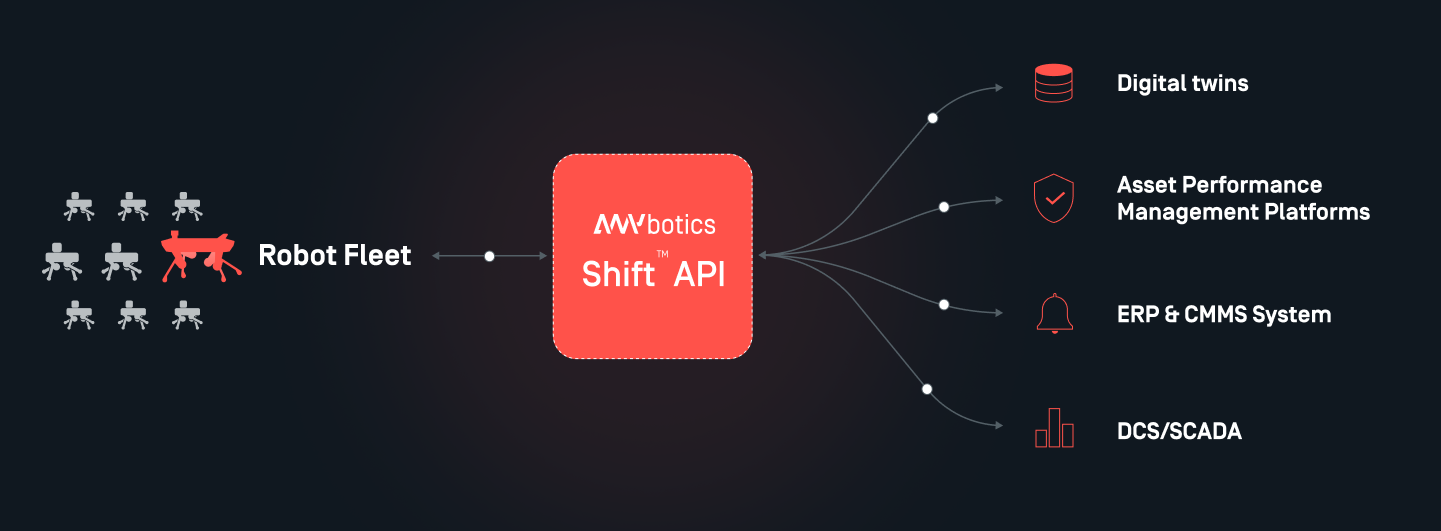
- Workflow integration. Notification Center sends findings through email, webhooks, and Microsoft Teams. The Shift API connects mission triggering and inspection data with systems such as SAP, GE APM, and Cognite.
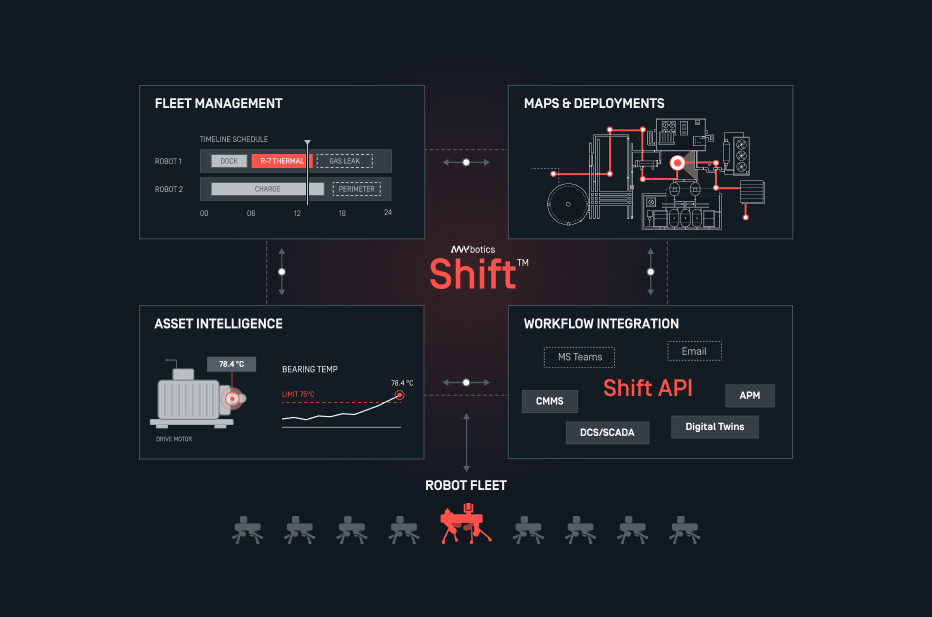
Across these four areas, Shift AI brings inspection data and asset context together. It analyzes visual, thermal, and acoustic data alongside inspection history and relevant process conditions, allowing teams to identify changes that deserve attention and decide what to do next. Confirmed findings can move into maintenance workflows, while a process threshold or external alert can trigger a targeted follow-up inspection, creating a continuous loop between inspection and action.
Why the name ShiftTM
Every plant runs in shifts: a day shift, a night shift, and a handover between them. Shift brings robot fleets into that rhythm. Robots complete scheduled rounds around the clock and hand over their findings and supporting evidence to reliability engineers and maintenance teams. Those teams can start their day interpreting results and planning action rather than collecting data.
Repeated inspections show how conditions change over time, giving teams a chance to act before a developing issue becomes an outage or safety incident.
As Jacob Euler-Rolle, Head of Product Management, Workflow Integration at ANYbotics, puts it:
“Robots now run their own shift around the clock. Shift schedules and supervises that work, then hands the findings and evidence to the team in the morning. This helps customers move from reactive to proactive maintenance.”
What this means for customers
What changes
With Shift 1.0 in October 2026, the name in the product interface, notifications, emails, and product documentation will change from Data Navigator to Shift. The rest of the interface will remain familiar.
Shift will also have a new product page and URL. Existing URLs will redirect to the new location, so saved bookmarks will continue to work.
What stays the same
Existing deployments will continue to run without disruption. The rename does not affect:
- Customer data or inspection history
- Product configurations or login credentials
- API endpoint names or existing integrations
- Pricing, packaging, contracts, or legal agreements
- Support contacts or processes
No action is required. The new name will appear automatically with Shift 1.0 in our next release in October.
Launching in October: Shift 1.0
Shift 1.0 brings the new name into the user interface and adds new ways to connect fleet operations and inspection results with what is happening in the plant.
- Integration of DCS/SCADA data provides operating context for each inspection result. Reliability teams can assess robot readings alongside the relevant process state, giving them more context for deciding when a change matters. When a process signal exceeds the configured threshold, the same connection can trigger a targeted inspection, sending the robot to collect physical evidence so that abnormalities can be verified.
- Comparison views now make it easier to analyze readings across time and operating conditions. Teams can see whether a change is part of normal variation or deserves closer attention, helping them focus on the findings most likely to require action.
- Webhook notifications are now available, making it possible to send mission and inspection alerts into external platforms like Microsoft Teams.
- Mission reports now capture task and mission failures in a chronological timeline so that you can see what happened and when during each step in a mission. You can now also subscribe to mission failure notifications independently of other mission events.
Together, these capabilities connect process signals, robot action, and inspection evidence in a more complete operational loop.
Our vision for ShiftTM
Today, Shift manages fleets of ANYbotics robots. As industrial sites introduce more robotic systems, they will need one place to assign work, coordinate different robots, monitor execution, and bring the resulting findings into plant workflows.
Our longer-term direction is to extend Shift to third-party robots and make the platform hardware-agnostic. We see it becoming a command center for robotic coworkers: the operational bridge between robot fleets and the operations and maintenance teams responsible for the site.
Shift’s API-first architecture is central to that direction. The platform’s capabilities can be accessed through the API, allowing customer systems and, in future, industrial AI agents to trigger work, monitor robot fleets, and use inspection findings as part of wider plant operations.
This ambition is grounded in experience from more than 200 robot deployments around the world. Those deployments have taught us what it takes to deploy and operate robots reliably in real industrial environments, and they provide the foundation for extending Shift across different robotic systems.
Ready to shift?
When robots cover routine inspection work consistently, maintenance teams can spend more time deciding what needs attention and acting before a small change becomes an outage. Shift brings fleet operations, inspection intelligence, and maintenance workflows together.
Explore ANYbotics ShiftTM or request a demo to see how autonomous robot fleets can improve coverage, plant safety, and asset reliability.